
It occurred to me recently that I repented from same-sex eroticism for the wrong reasons. Make no mistake, it was the right decision and it turned out fine. But if I’d known then what I know now—about sin, repentance, and especially God’s grace—I might have made the decision a little more faithfully, a little more trustingly, and with a better sense of who God was, who I was, and what would happen next.
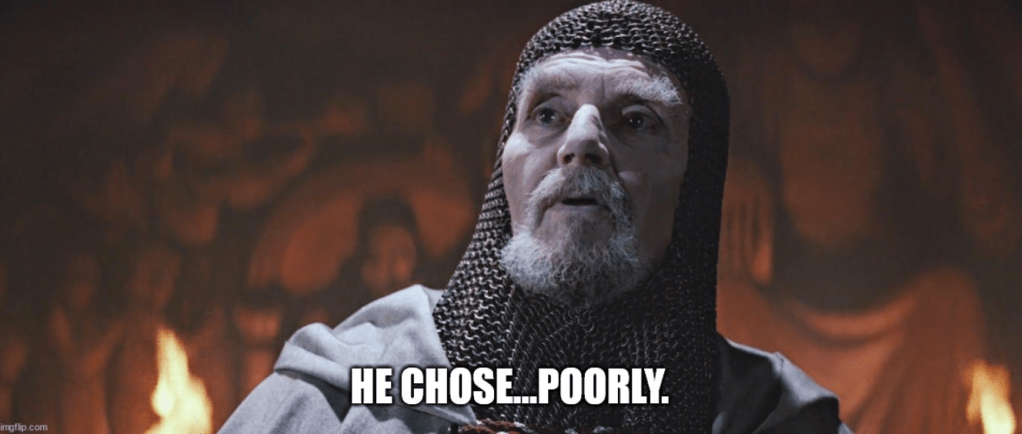
I call it my “first paradigm shift.” Out of nowhere, the Holy Spirit (who had so far been quiet about my years-long same-sex relationship to a man) suddenly started speaking. The message was simple. I had a choice: I could either walk with my same-sex partner, or I could walk with God; I couldn’t do both. I chose God. It was the right choice. But my reasons were… well, they were off. In my scramble to “choose wisely” and get myself on track, I overestimated my free will in the decision. In effect, I “chose wisely” because I was terrified of the consequences of “choosing poorly.” You might say I was motivated by the same horror Indiana Jones faced in that famous scene in Last Crusade (1989), in which his life (and his dad’s) came down to one make-or-break life-or-death decision. (Spoiler: Indy chose wisely and spared everyone’s life and rode off into the sunset.)
In my own decision, I was motivated by fear. The fear of hell, to be honest. Hell is a real place, and I don’t want to be there. But there were far better reasons to choose God that day besides fear of hellfire. By choosing fear of hell as my starting point, I accepted a grimness into my faith life that felt neither natural nor helpful. As a result, my image of God changed. It didn’t help that those were still the Exodus days. All of Wesley Hill and Gregory Coles’ reassuring words for SSA Christians inclined to sexual celibacy were yet to be revealed. I looked for support in the Side X movement and was startled to learn (from an Exodus-endorsed counselor) that my transition to heterosexuality was no likelier than any other dispositional change (such as overcoming depression), even with prayer and willpower. This made me even more fearful. I hated my same-sex attracted thoughts. And I missed my boyfriend. Surely that was wrong too, right? I went on like that for several years, wobbling on the edge of what I thought was a bottomless abyss, one “poor” thought away from the hellfire I wanted desperately to avoid.
Fast-forward. Two episodes in the Bible begin to haunt me. The first is the one about the Good Samaritan. I couldn’t get my mind off what the Good Samaritan did after bandaging the poor guy up:
Then he put the man on his own donkey, brought him to an inn and took care of him. The next day he took out two denarii and gave them to the innkeeper. ‘Look after him,’ he said, ‘and when I return, I will reimburse you for any extra expense you may have.’
—Luke 10: 34–35
I knew Jesus was teaching about more than being a good neighbor. He was also teaching about Himself. He was the Good Samaritan. I saw myself in the beaten-up guy, and imagined myself recuperating in that inn, off the street, safe from harm, my room and board paid for by someone who would one day return. I began to wonder whether some small part of my choice to repent had to do with Jesus Himself. And if some small part of it had to do with Jesus, didn’t that really mean that all of it had to do with Him?
Around the same time, a scene in the book of Acts took my breath away. Paul and Luke are sailing for Rome on a crowded Roman ship. Near the island of Crete, the ship encounters a storm that rages for fourteen days. By the end of the two weeks, the ship has only made it as far as Malta. In the midst of all the tossing and turning, Paul has a vision, which he reports to his traveling companions:
But now I urge you to keep up your courage, because not one of you will be lost; only the ship will be destroyed. Last night an angel of the God to whom I belong and whom I serve stood beside me and said, ‘Do not be afraid, Paul. You must stand trial before Caesar; and God has graciously given you the lives of all who sail with you.’ So keep up your courage, men, for I have faith in God that it will happen just as he told me. Nevertheless, we must run aground on some island.”
—Acts 27: 24–26
That sounds like good news, but Paul’s ordeal was hardly over. In fact, “running aground on some island” turned out to be the worst part so far:
When daylight came, they did not recognize the land, but they saw a bay with a sandy beach, where they decided to run the ship aground if they could. Cutting loose the anchors, they left them in the sea and at the same time untied the ropes that held the rudders. Then they hoisted the foresail to the wind and made for the beach. But the ship struck a sandbar and ran aground. The bow stuck fast and would not move, and the stern was broken to pieces by the pounding of the surf.
The soldiers planned to kill the prisoners to prevent any of them from swimming away and escaping. But the centurion wanted to spare Paul’s life and kept them from carrying out their plan. He ordered those who could swim to jump overboard first and get to land. The rest were to get there on planks or on other pieces of the ship. In this way everyone reached land safely.
—Acts 27: 39–44
Again, I dreamed myself into the scene. Tired and exhausted on an endlessly rocking ship, but God says I won’t be lost. And then it hit me: God plans trips to work out ahead of time, but He doesn’t necessarily make the trip free of trial or tribulation. That was pretty much the scene I was living in my own life, wasn’t it? An endlessly churning sea, death possibly moments away, and yet—the promise of safety. Could it be that God had already worked my safety into the story of my life? At first, the thought seemed presumptuous. Surely I was talking myself into complacency toward sin, that no good thing could possibly come of me seeing my destiny as secure. After all, if I did that, wouldn’t it mean I could just turn from my walk and go back to living the way I’d been living before?
It could have meant that. But the fact is, I didn’t want to.
As these two very different Bible scenes converged in my my mind, I gradually realized that God works even in my choices. They’re my choices, but with Christ in me, in some unfathomable way they must also be His choices. Maybe my life didn’t hang by a thread from each choice I made. Perhaps my choices mattered, but perhaps God also had the big picture of my life already in view. And maybe—just maybe—He was determined to make sure it got painted beautifully, just as He imagined it for me. With that realization, some of the harder scriptures in the Bible began to make sense:
And we know that in all things God works for the good of those who love him, who have been called according to his purpose.
—Romans 8: 28
I call that realization my second “paradigm shift,” but in fact it was just an amendment to the first, a cleaning-up with the scary parts removed. It had to happen. God didn’t want me to mis-apprehend the transformation that had taken place in me. For one thing, He didn’t want me to take credit for it. Nor did he want me to see myself as quite so influential in my own life.
—by Rick E.
 For Freedom