
It is easier for me to show mercy to others than to myself. I think I know why this is: not too many years ago, I was harsh in my judgments of others, but gave myself a nearly infinite leash in matters of morality. My sense of right and wrong were desperately warped, both for myself and others. This remained true even after I came to faith. I’m grateful that the Holy Spirit redirected me, but I often fear I swing too far the other way. I bend over backwards to overlook the missteps of others—even egregious ones—while scolding myself severely for a very small lapse on my part.
Avoiding extremes?
Humans gravitate to absolutes. We identify absolutes easily. Absolutes are convenient because they stand out. For example, it is easier to find a black button on a white carpet than on a black carpet (or a blue button on a purple carpet). I find it easier to dress for a day that is simply cold than for a day that is in-between-temperature-with-moments-of-warm-sun-and-an-occasional-chilly-breeze-with-sprinkles-of-rain. Biologists would say my tendency to view things in absolute terms helps me survive. If that is so, it doesn’t seem to help me much in my Christian walk.
Ecclesiastes, the same book that touts “a time for everything,” warns us against wandering to extremes, even extreme righteousness or wisdom, which can “destroy” us (7: 16). How can this be? The answer lies a few verses further on:
It is good to grasp the one and not let go of the other. Whoever fears God will avoid all extremes.
—Ecclesiastes 7: 18
Here the author is talking about righteousness and wisdom. His point is not that we should avoid great righteousness or great wisdom, but rather that we should avoid building up one while neglecting the other. The author of Ecclesiastes suggests that it is easy to have one or the other, but harder to have both at the same time. Why is this? Righteousness can possibly be measured in actions, thoughts, and words. Wisdom, on the other hand, is elusive:
“I am determined to be wise”—
but this was beyond me.
Whatever exists is far off and most profound—
who can discover it?
—Ecclesiastes 7: 24
Because it takes wisdom to embrace the uncertainties of life and the unknowableness of the mind of God, wisdom is closely tied to mercy, as James tells us:
But the wisdom that comes from heaven is first of all pure; then peace-loving, considerate, submissive, full of mercy and good fruit, impartial and sincere.
—James 3: 17
Our righteousness walks hand in hand with our wisdom, which is expressed in the unexpected mercies we extend to others—and (if we’re doing it right) to ourselves.
Finding the balance
As I’ve said already, it’s easier for me to extend mercy to others than to myself. But since mercy comes through wisdom as a gift from heaven, I know I must let some of that mercy reach me as well. This makes me nervous. Just how attentive should I be to my actions, words, and thoughts? This question is important to ask since righteousness in Christ means something very specific. Since I am in Christ, my righteousness is His, not mine (Philippians 3: 9). Sanctification, then, comes from God as a free gift, and I must open myself to it:
Submit yourselves, then, to God.
—James 4: 7
Humble yourselves, therefore, under God’s mighty hand, that he may lift you up in due time.
—1 Peter 5: 6
Trust in the Lord with all your heart
and lean not on your own understanding;
in all your ways submit to him,
and he will make your paths straight.
—Proverbs 3: 5–6
But a fruitful walk with Christ calls for my cooperation. This is clear from many scriptural instructions not just to surrender to God, but also to strive actively, just as I would in any relationship. Look at all the action verbs in these next verses—these are things we are called to do or not do as we walk with Christ:
Strive to enter through the narrow door. For many, I tell you, will seek to enter and will not be able.
—Luke 13: 24 (ESV)
Therefore, I urge you, brothers and sisters, in view of God’s mercy, to offer your bodies as a living sacrifice, holy and pleasing to God—this is your true and proper worship. Do not conform to the pattern of this world, but be transformed by the renewing of your mind.
—Romans 12: 1–2
For the grace of God … teaches us to say “No” to ungodliness and worldly passions, and to live self-controlled, upright and godly lives in this present age….
—Titus 2: 11–12
Therefore, since we are surrounded by such a great cloud of witnesses, let us throw off everything that hinders and the sin that so easily entangles. And let us run with perseverance the race marked out for us, fixing our eyes on Jesus, the pioneer and perfecter of faith.
—Hebrews 12: 1
We’re called to surrender and to strive. Let’s think of these as two responsibilities that need to be in balance:
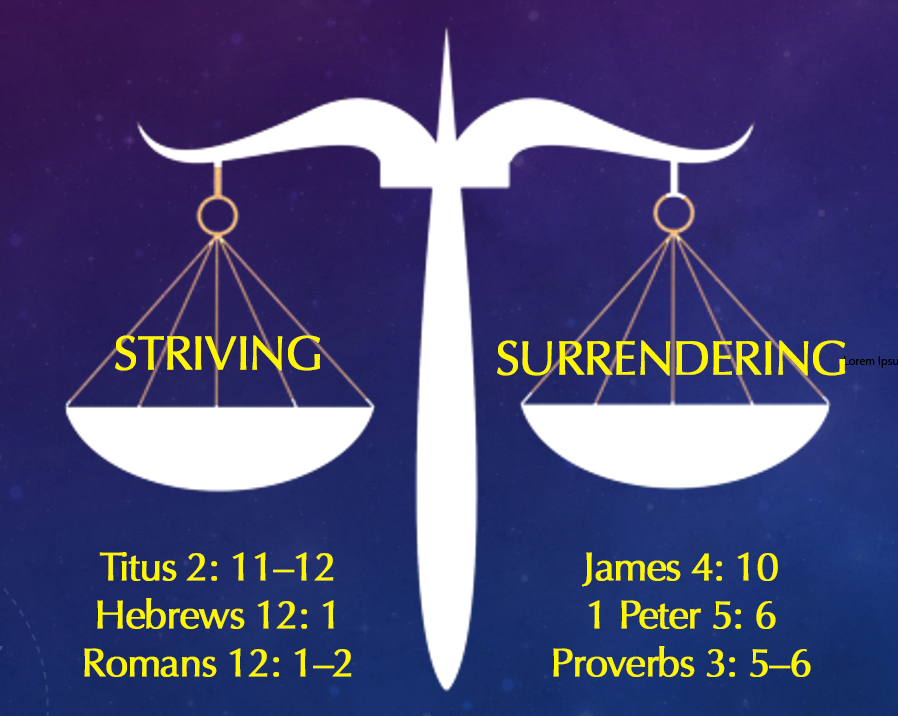
I personally struggle much more with surrendering than with striving. It’s easy for me to “get busy” when I see a fault in myself, and even easier for me to let my cooperation with the Spirit devolve into self-directed acts of “righteousness.” Striving feels good, since it makes me feel I’m in control. Surrender, on the other hand, requires me to yield to the unexpected, unpredictable wisdom of God. This is much harder—my flesh pushes against it. Yet surrender is uniquely satisfying. When I surrender to God, I’m reminded that I’m not confronting sin alone, but rather participating in the work of the Holy Spirit, who is completing what Jesus Christ has begun.
My flesh longs to upset this balance. Fortunately, I can tell when the balance is off, because my life starts to bear strange fruit. When I lean too much on striving, I get overly focused on words, deeds, and thoughts as the goal, and I start to think of myself as very disciplined and clever, a master of formulas for living. Too much surrender, on the other hand, and I soon get lazy in my walk and stop responding to the Holy Spirit altogether, for example, by not putting forth an effort to move my feet and walk in the direction He is leading.
Final thoughts
Striving and surrendering involve a tricky balancing act. I find that striving can get discouraging, especially when I strive against sin repeatedly, yet feel I’m losing the battle. Yes, there are days when I simply don’t want to “throw off the sin that hinders.” That’s my fallenness at work. If you have days like that too, recall Psalm 107. In this psalm, Israel wanders in the desert wastelands crying out to the Lord. Each time they cry out, God delivers them from their distress and leads them by a straight way. When they again go astray, God leads them out of darkness again. And again! The point of Psalm 107 is not that Israel grows to a point of spiritual perfection and no longer needing God, but rather that God accomplishes marvelous and unmerited deliverances again and again when called upon. Ultimately, they are to ponder the loving deeds of the Lord (v. 43).
We must do this too. Though we wander in the desert (whatever that may be), we must cry out to God and surrender ourselves to His unfathomable mercy. Even though God reigns with both justice and mercy, it is His mercy that triumphs (James 2: 13). This means that for those who love God and seek Him, God’s mercy—the expression of His deep, unfathomable wisdom—always gets the last word.
—Rick E.
 For Freedom